

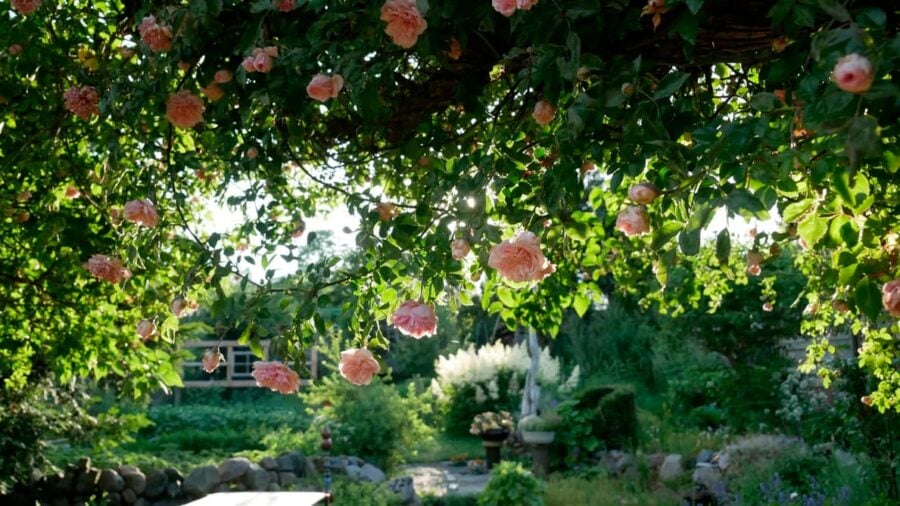


A forest at home: the Miyawaki method of reforestation
Akira Miyawaki was a Japanese botanist that couldn’t bear to see the native forests of his country become increasingly brittle, weak and flammable. In developing what would become a method for growing urban forests, Miyawaki observed that, by the mid 70s, less than 1% of all new planted species in Japanese forests were native to Japan.
Behind this problem are macrofarming and monoculture planting for agricultural exploitation factors, besides the widespread habit of mindless choosing of plants for reforestation and the import of invasive species.
The inestimable contribution of professor Miyawaki consisted in the research and development of a method that allowed for a rapid but long-lasting and useful regeneration. Because, as his work proved over and over, when a habitat has native species, it becomes much more resilient, stable and sturdy.
Diversity is resilience
Observation and experience tell us that if we leave alone a reasonably big piece of land in a temperate climate, nature will eventually turn it into a forest.
Forests are naturally diverse. The sadly widespread practice of colonizing vast extensions on land with single-species crops that displace native forests have led us to think that this kind of homogeneous presentation is normal in nature. It’s the other way around.
It is highly unusual for a single plant species to monopolize a portion of land outside of human intervention, let alone to do it in a symmetrical and synchronical fashion.
One of the reasons why nature chooses to diversify as much as possible in the smallest possible space is because this is the best strategy to survive. We think that it’s the effects of climate change and its extreme temperature alone that will jeopardize our crops. However, we are seeing increasing evidence that what kills plants is not just temperature but extreme climate events. Torrential rains, violent gusts of wind, heavy hail, wildfires and landslides are the doom not just of our crops, but of single-species forests.
The greater the biodiversity we find in a forest, the greater its capacity to resist. The soil holds better, the wildfires have a harder time progressing, and whenever there is a catastrophe, the area recovers up to ten times faster than single-species zones.
The unexpected use of an ecological practice for urban forests
Originally, Miyawaki’s method was developed to efficiently reforest areas damaged by wildfires, drought, agricultural operations, etc. However, it was so effective in forest development that people in Japan started to use it domestically, and the results are astonishing.
Following Miyawaki’s method, one can grow a sustainable home garden that requires little irrigation and stands the test of time.
Typically, a forest takes up to a hundred years to spontaneously develop in nature, and it can take up to a thousand to fully mature. However, a specific combination of native species can shorten the process to a span as short as ten years.
This is why landscaping trends have adapted Miyawaki’s method to create little forests in private land to turn backyards into dreamlike landscapes. Having a forest at home is not that difficult.
How to plant a garden forest
Miyawaki’s method is very simple. Simplified, it is all about replicating the conditions in which primeval forests organically grow.
You don’t need a lot to have a small forest in your backyard. You don’t even need a big plot of land: Miyawaki’s method has proved to be successful in spaces as little as 9×9 ft.
- Make a preliminary research of native species in your area. Plants know where they live, and through the adaptive waves they have learned to make the most of the natural resources at their disposal. Don’t put palm trees in your garden if you live in Norway and don’t use conifers in the south of Spain. Check out your local nursery, and design a diverse mix of native species to the area.
- Prepare the soil. Mix plant-based materials that enhance the permeability of the soil: cereal shells, pruning leftovers, wood kindles, etc. Ask local businesses that have those kinds of materials as byproduct or waste (such as a carpentry, sawmill, shipyard, agricultural plantation, etc) to get the material. Add manure on top of it.
- Organize your plants by the height they will reach in their prime. The layers in a forest are classified by height: there are ground-level plants, shrubs and bushes, medium height trees, high height trees and vines. Make sure to distribute your plants in a way that same species nor same height plants overlap.
- Don’t follow a pattern. You can divide the ground in quadrants for better planning, but don’t leave a symmetrical space between the plants. Remember that the idea is to mimic the conditions of a natural forest, where perfect symmetrical order doesn’t exist.
- Water your forest once a day, and keep it weed-free for the first two years. It will shock you how fast it can grow, and in barely a decade it will be self-sufficient, meaning, it will take care of itself.
An urban forest with Miyawaki’s method and the island of Alboranic biodiversity: two nature based solutions
Just as professor Salvo Tierra told us, there is a growing movement of nature based solutions among environmentalism, which means to look for restorative and preventative measures within nature itself. This movement doesn’t aim to invent anything new, but to observe what nature does to fix itself and extract patterns and mechanisms from it, to implement both locally and globally.
This is what we have done in todobarro’s eco farm with our island of Alboranic biodiversity. In fact, our island shares a good deal of features with Miyawaki’s method. Both models support native species, take bioclimatic factors into account and have restorative effects in its environment.
Complement your garden with our fired clay floors and tiles
The best complement for a wild garden is fired clay. Create a relaxing, elegant and natural atmosphere with our original terracotta floor patterns and designs, made by hand by our master craftsmen.
We submit all of our pieces to a controlled aging process that provides our signature Antique texture. It will look like the pavement in your garden has been there for years, and yet it will retain the freshness and novelty of a new made product.
Take a look at our terracotta floors, and don’t hesitate to ask our team what kind of tiles would work better for your home forest.




Top stories

What is the Nature Restoration Law?
The Nature Restoration Law is a European regulation approved in 2024, aiming to ensure the necessary actions and initiatives to repair damaged ecosystems and…

Acequias or irrigation ditches: an ancient knowledge making its comeback
“Acequias” (ditches) are one of the oldest existing systems of channeling and use of water. In the Iberian Peninsula we know them well: the…

What is a compensatory measure?
By definition, a compensatory measure is an action aimed to restore or repair de negative environmental impact of any give activity -usually of a…

What are Zellige tiles?
The word zellige means ‘polished stone’ in Arabic. It refers to a type of traditional tile and mosaic technique characteristic of Morocco and the…
