

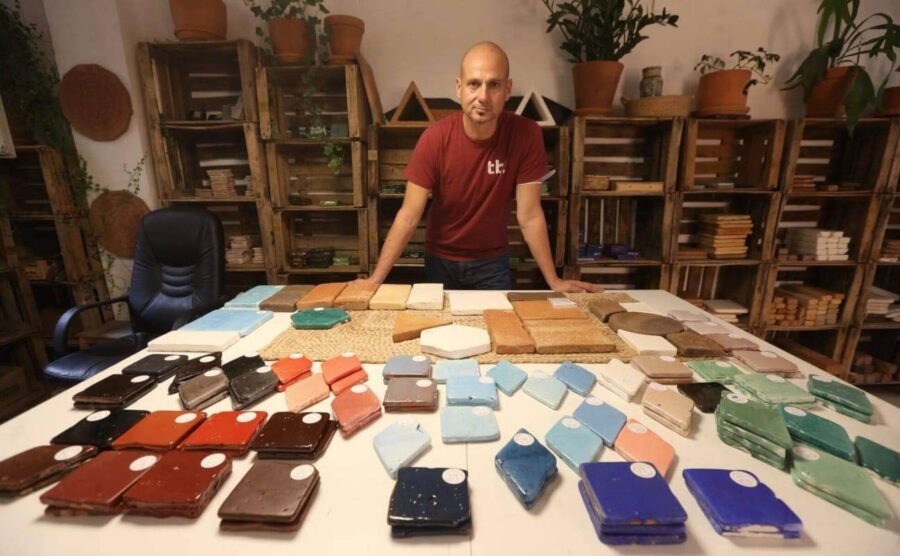


Pedro Rosa, todobarro’s ceo, in a feature piece for Diario Sur
Successful business stories are rarely -if ever- linear. Such is the case for our CEO, Pedro Rosa, whose journey here couldn’t be fuller highs and lows. “At the end of the day, it all comes down to persistence, but fifteen years ago nobody talked used the word resilience”, says Pedro on this feature piece for Diario sur, a leading publication in Málaga.
Pedro Rosa: a long business trajectory that bypassed its setbacks
Even if today todobarro is often cited as a success story, our CEO talks about how that wasn’t always the case. The beginnings were immensely challenging. It even came to a point where help from family and friends was unavoidable to carry on. He says: “Spain is a difficult country for second chances. The national economy is not built for that. It is common in countries like the USA, but here it has to be protected by law, because the market won’t allow you to recover from failure”.
But just when everything seemed to point towards defeat, an old idea came resurfaced: fired clay tiles. As the Diario Sur piece says:
Clay came into his path over twenty years ago, when he realised that the old, worn-down terracotta tiles -which were being discarded in foreclosure demolitions due to the 2008 real estate bubble-burst that swept the country-, were ending up in luxury homes and villas abroad.
“There were companies that specialized in picking up that material and selling it to intermediaries that in turn put it into circulation in very exclusive markets”, Rosa says. “It was a good business, but it depended on demolitions”. So, said and done, he set it up on himself to bring back the natural resources that would allow to get the texture, color and shape of old-time fired clay that was so in demand.
The next few years allowed Pedro to carry his idea over unexpected paths. That is how he made space for young designers and new formulas to get the feeling of old fired clay exactly right. And, in the meantime, he discovered all its goodness. “It is a very kind material to the environment. It absorbs humidity and releases it slowly, which is why the clay-clad areas of a home are cooler even on the hottest days”.
In summary, it is a comprehensive piece of journalism that thoroughly covers our CEO’s story. Big thanks to Diario Sur and Alberto Gómez for the space and care given to Pedro (and us) on their coverage.


Top stories

What is the Nature Restoration Law?
The Nature Restoration Law is a European regulation approved in 2024, aiming to ensure the necessary actions and initiatives to repair damaged ecosystems and…
Acequias or irrigation ditches: an ancient knowledge making its comeback
“Acequias” (ditches) are one of the oldest existing systems of channeling and use of water. In the Iberian Peninsula we know them well: the…
What is a compensatory measure?
By definition, a compensatory measure is an action aimed to restore or repair de negative environmental impact of any give activity -usually of a…
What are Zellige tiles?
The word zellige means ‘polished stone’ in Arabic. It refers to a type of traditional tile and mosaic technique characteristic of Morocco and the…
