



Succesful presentation of “Lab Patio 2.12”: todobarro’s experimental project to cool a house without using any energy
We prove how to combat extreme heat in a sustainable way through science, craftsmanship, and vernacular architecture: we lower the temperature by up to ten degrees using only passive measures
The project “Lab Patio 2.12” is one of todobarro’s research and development initiatives around the possibilities of clay as a bioclimatic material.
Last week, our head of environmental R&D, Pedro Guerrero, and Pedro Rosa, CEO of todobarro, along with the Vice Rector for Research and Scientific Outreach at the University of Málaga (UMA), Pedro Maireles, and Ferrán Ventura from the Chair of Advanced Environmental Architecture, presented the project on site, in a space set up next to the Casa Patio, where they explained the process, our findings, and what is expected and hoped for the future of the project.
We proved how the application of fired clay in bioclimatic architecture can not only eliminate a building’s energy consumption required to achieve thermal comfort, but also create a temperature difference of up to ten degrees Celsius between the interior and exterior through optimized and sustainable processes that also have a positive impact on the environment.
An oasis in a desert of asphalt: the conditions at Casa Patio
The “Lab Patio 2.12” project is located in a parking lot on the Teatinos campus of the University of Málaga. The space where the Casa stands is one of the infamous urban heat islands: areas completely paved with asphalt or cement that absorb and accumulate solar radiation. The surface temperature of areas like this can reach up to 80ºC during the height of summer.
Inside the Casa, however, the temperature and humidity conditions are ideal (to the point that it’s not unusual to hear people murmuring they wish they’d brought a light jacket). These conditions have been achieved without plugging in a single appliance; the Casa cools itself. In summer, there’s a difference of up to ten degrees compared to the outside, though we’ve often recorded even greater differences on the hottest days. How did we do it?
The two cornerstones of the project: terracotta and the Mediterranean patio
For centuries, Mediterranean cultures have intuitively used bioclimatic principles to shelter from the heat. Although prolonged extreme temperatures are a hallmark of our times, the Mediterranean basin has always endured summers exceeding thirty degrees, and even forty in some desert areas.
We know that if our ancestors were able to transform these conditions into places that were not only habitable but almost paradisiacal, it was thanks to their deep understanding of their land and the constructive materials they used. In developing this project, we have turned our gaze to this body of millennia-old Mediterranean architectural practices.
In this space, we have discussed at length the bioclimatic characteristics of the Mediterranean patio, a staple of our vernacular architecture. We have also spent years researching the thermoregulatory properties of clay and terracotta. At the intersection of these two elements, we have developed a series of architectural features that, when applied in combination, ensure thermal comfort within the house.
Bioclimatic terracotta screens: cooling a house with clay and science
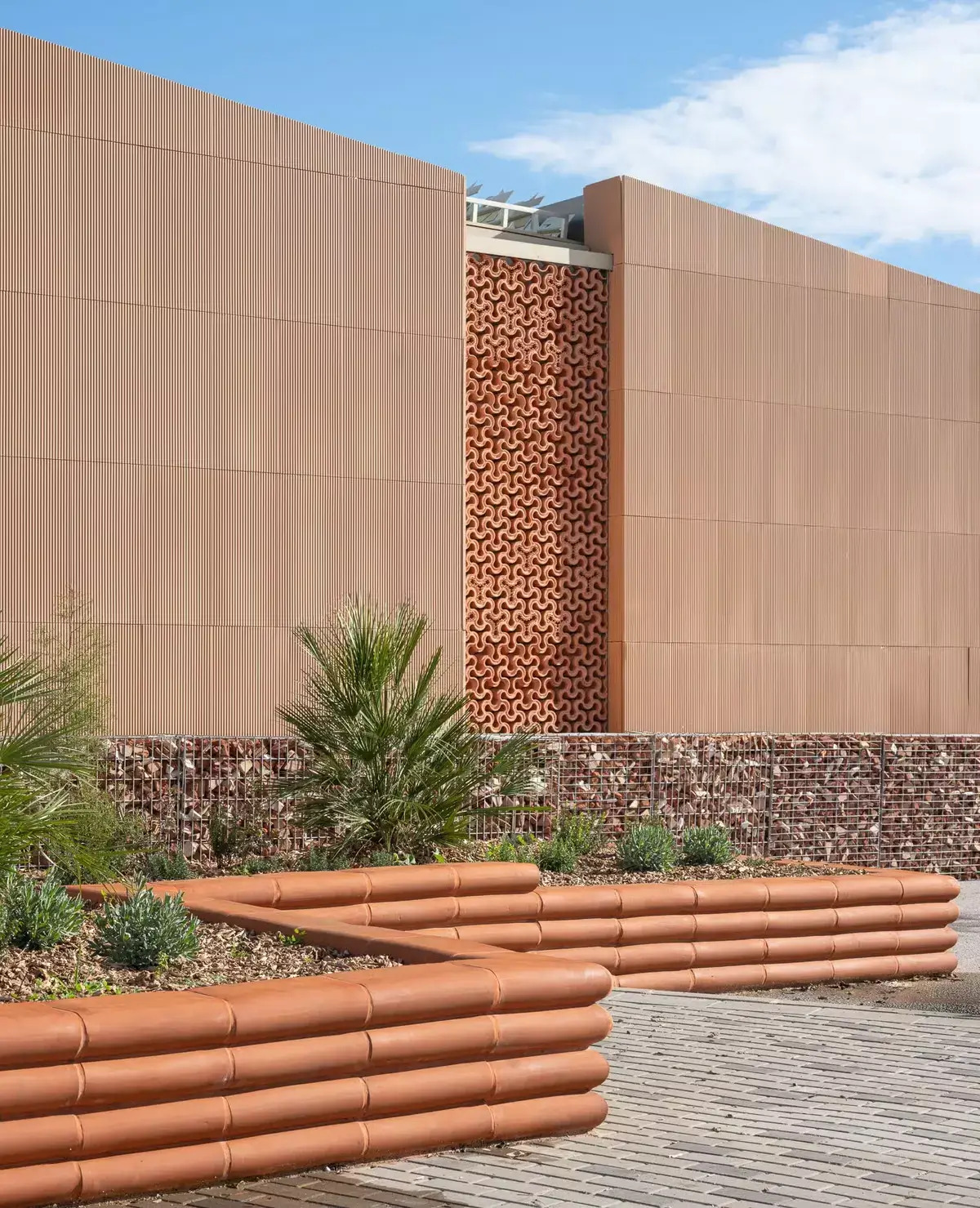
Two of the house’s walls are made up of terracotta screens panels that were specifically designed and crafted for this project. The screens are made of pieces consisting of three lobes that all interlock with one another. The specificity of their geometry is based on mathematical rather than aesthetic criteria. Unlike our terracotta screens, which are handmade by our master artisans (who not only allow for imperfections but actually benefit from them), these pieces were produced using 3D printing to ensure the highest scientific precision.
These panels have been strategically oriented in relation to the area’s wind patterns. When warm air passes through the latticework, its speed increases and its pressure decreases (a widely studied physical phenomenon known as the Venturi effect). This phenomenon helps extract warm air from the interior and draw in fresh air.
But the Venturi effect alone does not cool the air (although it does contribute to a sensation of coolness). What actually lowers the temperature on the thermometer inside the house is the combination of the Venturi effect with the evaporative cooling of the clay: the terracotta retains moisture and gradually evaporates it. This process does absorb heat from the environment, cooling the air that passes through the latticework to enter the house. We commonly refer to this evaporative cooling as “the botijo effect.”
When the thermometer exceeds certain temperatures, a drip irrigation system is activated to moisten the screen panels, increasing the system’s effectiveness. This mechanism creates an exponential benefit: the hotter it is outside, the more noticeable the temperature difference is inside.
Terracotta walls with integrated self-watering systems
In addition to the terracotta screen panels, there are two other vertical terracotta elements that contribute to thermal regulation inside the building. One of them is a vertical garden with an integrated irrigation system, which also contributes to the aforementioned evaporative cooling.
The other is a ceramic wall equipped with an irrigation system. Like the louvered panels, this system activates when certain temperatures are exceeded. This experimental wall directly explores the possibilities of evaporative cooling without associated phenomena, yielding positive and surprising results for the entire team.
The amount of water these systems require to remain moist and achieve their objective is actually very small, especially when compared to the performance they contribute to the system’s efficiency.
Perimeter of native vegetation
Finally, a Mediterranean garden has been planted along the entire perimeter of Casa Patio, featuring a carefully selected combination of native species that require minimal irrigation and are resilient to high temperatures. The garden’s design follows bioclimatic principles, and not only does it help improve thermal comfort inside the home, but its impact will continue to grow as the garden matures.
As Pedro Guerrero explained: “This garden will be open to the academic community, which is why several resting areas have been created within it. The gabions in the flower beds—built in the style of traditional dry-stone walls using the leftover clay from the terracotta screens—serve as benches. These gabions help retain soil moisture, aerate the roots, and create habitats for local wildlife and insects.”
A testament to public-private collaboration
The “Lab Patio 2.12” project is yet another example of the progress that can be achieved when synergies and collaborations are created between the Public Administration and private entities that invest in research and innovation—not only for the industry itself, but also to develop products, protocols, and practices that have a real positive impact on their context.
The Casa Patio de Teatinos has become a reality thanks to todobarro, the Chair of Climate Change and the Bilba Chair of Environmental Architecture at the University of Málaga, the Center for Technological Development and Innovation (CDTI), and the Innovarcilla Foundation.
Media coverage
Una casa-patio instalada en el Campus de Teatinos investiga cómo reducir el calor sin consumo energético – Cadena SER
Fresca y eficiente, la casa mediterránea basada en el ‘efecto botijo’ – CanalSur
La casa de barro que desafía al calor de Málaga sin aire acondicionado: así es el nuevo laboratorio de la UMA – El Español
La UMA crea un centro de demostración de soluciones bioclimáticas para edificios en Málaga – Diario Sur


Top stories

We participated in the first regional workshop on sediment revalorization, organized by the European SED’UP project
On September 29, we participated as speakers in the first regional workshop on sediment upcycling. This is an increasingly researched and practiced field, which…

todobarro at Gateway Summit 2026, the season’s event for entrepreneurs
Pedro Rosa, CEO and founder of todobarro, has been invited to a panel discussion titled “Local Heroes: From Andalucía to the world, innovating locally,”…