



NYC CoolRoofs: New York Turns to Andalusian Vernacular Architecture to Combat Climate Change
Our colleagues Marta Sader and Samuel Vega explain to La Vanguardia how traditional Mediterranean bioclimatic techniques are evergreen survival strategies
Urban heat islands, extreme heat waves. These are two concepts that, for the sake of every living being, should grow increasingly distant from one another. Our planet is rapidly warming, and we no longer perceive this merely in theory: every summer, millions of people (and ecosystems) suffer from temperatures far exceeding our thermal stress threshold.
Urban planning and the materials used in our cities are not designed to protect us from heat that is becoming increasingly problematic. Cement, asphalt, and concrete are materials that absorb solar radiation and do not release it, creating what we know as urban heat island: enormous pockets of heat retention that, in cities, exponentially increase temperatures that are already far too high. And where is this issue more urgent than in the city of cities: New York.
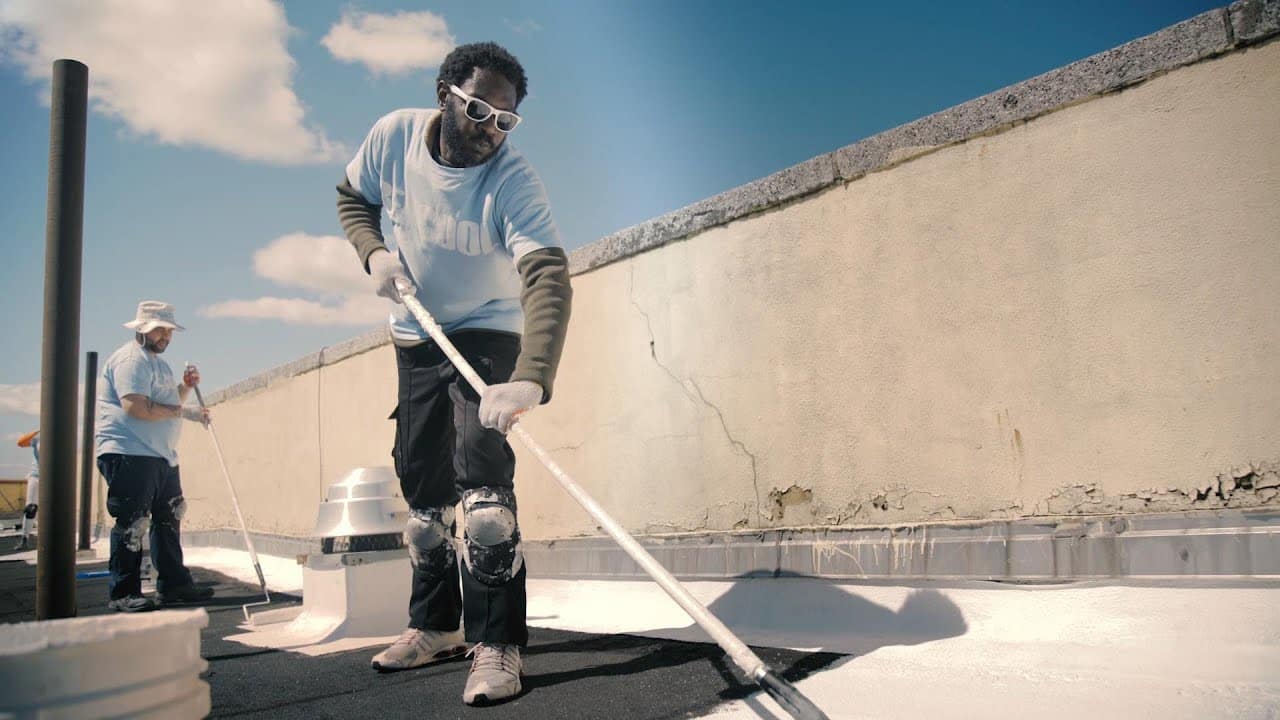
For more than twenty years, the City of New York has offered a program (NYC CoolRoofs) to its residents that addresses two needs: it lowers the temperature of buildings, increasing comfort while reducing energy consumption and environmental pollution, and it provides training and jobs to New Yorkers seeking employment. And it does so through a practice we know very well in Andalusia: whitewashing roofs.
The keys to vernacular architecture: when we had the answer before we even asked the question
Our colleagues, Samuel Vega and Marta Sader, spoke with journalist Paula Martínez of La Vanguardia a few days ago for an article titled Andalusian artisans analyze the technique of painting rooftops white to combat the heat. In the piece, Samuel explained that: “many of the simplest strategies for defending against the climate emergency have been part of Mediterranean building traditions for centuries.”
Before apartment buildings, air conditioners, and paved roads, our ancestors also had to protect themselves from the heat. And just as living organisms adapt to their environmental conditions to survive as efficiently as possible, human strategies for adaptation and survival have also been refined over centuries of inhabiting the Mediterranean basin.
At todobarro, we have spent years exploring the possibilities, characteristics, and iterations of our vernacular architecture to develop solutions that allow us to tackle the climate crisis with concrete responses and to harness the bioclimatic applications of fired clay—a material that has been shielding us from the cold and protecting us from the heat for millennia.
In the course of this research, we have developed projects such as the “Lab Patio 2.12” project, where we have demonstrated that passive measures, drawn from traditional Mediterranean bioclimatic architecture, can reduce the interior temperature of a home by up to ten degrees without using a single watt of electrical energy. The project was highlighted in an LV article as an example of excellence in bioclimatic architecture.
NYC CoolRoofs: facing the climate crisis as a measure of social cohesion
The CoolRoofs program aims to lower the city’s temperature by up to three degrees, reduce buildings’ energy consumption, and create a network of shared knowledge and social cohesion among New Yorkers through resilience to climate change.
After nearly twenty years in operation, data clearly shows that the program works. Having dark rooftops coated with asphalt or tar—as has traditionally been done in Manhattan—means that during heat waves, building roofs essentially turn into ovens that radiate heat down to the foundations. These materials are inexpensive and provide good insulation against rain, but they retain so much heat that they can reach up to 176ºF (80°C) on a day of direct sunlight, and would require many more hours of darkness than a night provides to cool down again.
Roofs are coated with two layers of white silicone paint to reflect solar radiation, which reduces the temperature inside buildings by up to 30%. For a roof to be eligible to participate in the program, it must meet several requirements:
- The roof must be flat
- It must be in good condition
- It must be easily accessible, without the need for ladders or climbing through windows or hatches
- It must not have any hazardous machinery installed
- The roof covering must be one of the following:
- Bitumen
- Modified bitumen
- Asphalt
- Granulated roofing membrane
Many buildings are eligible for renovation at no cost, such as low-income housing, cultural organizations, or public community centers. This is a paid program that offers participants work and professional experience in the construction sector, and volunteer opportunities are also periodically made available to New Yorkers who wish to participate on a volunteer basis.
This is a model worth emulating, demonstrating how climate change coping measures can serve as a vehicle for job creation and social cohesion. However, if the program is to be replicated, it would be wise to consider that certain key aspects of traditional Andalusian whitewashing—which we explain in this article—would significantly improve the effectiveness of this practice.
©Cover image: United Nations


Top stories

todobarro at the university of Lille: decisive progress in the SAFARI Ports project
Over the summer, members of our R&D department traveled to northern France to participate in a scientific-technical workshop at the University of Lille. The…

The prestigious journal Cuaderno (335) from the University of Palermo (Buenos Aires) features a paper about Lab Patio 2.12
Cuadernos del Centro de Estudios en Diseño y Comunicación is an internationally recognized, peer-reviewed academic journal that has been published continuously by the School…

Andalusian whitewashing revalidates its importance against the climate crisis
Last month, Spanish paper La Vanguardia asked our coworkers Samuel Vega and Marta Sader about the whitewashing technique, called “encalado”, we’ve used in Andalusian…
The Malaga College of Architects has selected our Casa Patio project for the 2026 Architecture Awards
More than 120 candidacies were submitted for the 18th edition of the Málaga Architecture Awards, one of the most prestigious competitions in the sector…